Borrowing Against Mined Coins When Bills Arrive Before Payouts
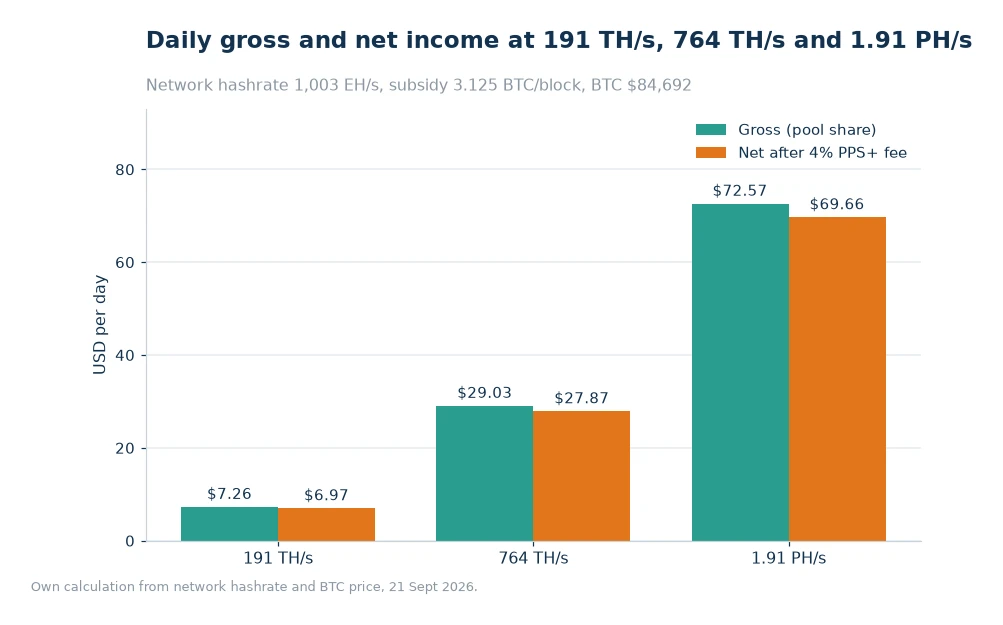
A power bill due this Friday can hurt even when the rigs earn well. A 191 TH/s setup grosses $7.26 a day at the 21 September inputs and nets $6.97 after the listed 4% on the block-reward component. When that steady flow still leaves a short-term gap, pledging mined coins as collateral can bridge the week without selling the stack.

Key takeaways
- 191 TH/s produces 8.568e-05 BTC daily, worth $7.26 gross and $6.97 net at BTC $84,692.
- 764 TH/s earns $29.03 gross and $27.87 net; 1.91 PH/s earns $72.57 gross and $69.66 net.
- Collateral-Pledged Loans follow five steps: add collateral, apply, receive funds, repay, redeem.
- Borrowing suits dated invoices, not hashrate expansion; size the loan to the bill, not the dream.
The cash-flow gap miners actually face
Mining income arrives as a slow daily drip while costs arrive as monthly thuds. A 191 TH/s operation nets under fifty dollars a week, yet its electricity meter spins toward a quarterly invoice several hundred strong. Selling coins at whatever price Friday happens to offer closes the gap but surrenders any later recovery. The alternative is treating mined coins as what they are: an asset that can stand behind a short loan.
Timing explains most borrowing. Difficulty at 132.76 T and a network near 1,003 EH/s fix the daily drip at about 0.00000044865 BTC per terahash, so income is predictable to the cent while price at $84,692 is not. A miner who believes the quarter favours patience but owes the utility on the first of the month has a calendar problem rather than a profitability problem. Calendar problems accept calendar solutions.
How pledging works, step by honest step
Collateral-Pledged Loans run a fixed sequence that leaves little room for confusion. First the miner adds collateral from the account balance into the loan facility. Then comes the application stating amount and term. Approval releases the loan funds for use against bills or operations. Repayment follows on schedule, and once cleared, the miner redeems the collateral back into the free balance. Five moves, each visible in the account history.
The ViaBTC Crypto Loan desk structures this for mining balances specifically, so pledged coins come from earnings the pool already settled rather than from an external wallet transfer. That detail matters operationally: hourly PPS+ credits keep accumulating toward the same account while the loan runs, which means incoming mining income can service the obligation without extra transfers. Borrow against the stack, repay from the stream.
What the rig earns while the loan runs
Collateral does not pause the machines. The 191 TH/s setup behind this piece keeps posting 8.568e-05 BTC a day through every stage of the loan, worth $7.26 gross and $6.97 net after the listed 4% on the block-reward component. At 764 TH/s the day reads $29.03 gross and $27.87 net; at 1.91 PH/s it reads $72.57 gross and $69.66 net. Those flows are the repayment engine, and any loan sized beyond a few weeks of net income deserves a second reading.
A practical ceiling keeps borrowing sane. Add one month of power costs, compare against one month of net mining income, and borrow only the shortfall between them. The listed pool fee information confirms the deduction already inside the net figures, so no further haircut hides in settlement. Loans sized to dated invoices get repaid; loans sized to optimism get renewed, expensively.
Compare pledging against the obvious alternative with cold numbers. Selling 0.01 BTC at $84,692 raises about $847 today but surrenders every later dollar of its movement; pledging the same coins for a $500 advance against a $500 invoice keeps the exposure while costing only the facility's own terms. If price climbs 10 percent during the loan, the seller has locked in an $85 regret while the borrower repays from the $6.97 daily stream and keeps the upside. If price falls instead, the seller looks clever for exactly one month and the borrower simply repays and moves on. Borrowing is the choice that preserves optionality, priced accordingly.
Collateral value moves with the market, so borrow with headroom. Facilities typically expect the pledged cover to exceed the advance by a stated multiple, and a sharp dip can trigger a top-up request at the worst moment. Pledging twice the minimum, borrowing well under the maximum, and keeping one unencumbered month of income in reserve turns a margin call from a crisis into an errand. Never pledge coins you would be forced to top up with money you do not have; the power company accepts cash, not explanations. File the loan agreement, the invoice it covered, the repayment dates and the final redemption confirmation in one folder, then reconcile that folder against the payout history at month end. Clean files turn next quarter's borrowing into a ten-minute decision.
Parking the proceeds where they help
Approved funds and daily earnings need a tidy home. A multi-currency account wallet holds pool payouts, collateral records and loan balances under one login, which turns repayment day into a few clicks rather than a cross-platform expedition. Earnings land, obligations deduct, and the remaining balance stays visible without spreadsheet archaeology.
Discipline extends to conversion choices. Auto Conversion can rotate between supported coins when the loan or the power contract denominates differently, and the 20-coin menu including BTC, BCH, LTC with DOGE merged mining, KAS, ZEC, HNS, CKB and ETC keeps options open. Resist converting pledged collateral mid-loan unless the terms explicitly allow it; encumbered coins should sit still until redemption releases them.
| Mining scale | Coins per day | Gross value | Net value |
|---|---|---|---|
| 191 TH/s, one strong rig | 8.568e-05 | $7.26 | $6.97 |
| 764 TH/s, four rigs | 0.00034273 | $29.03 | $27.87 |
| 1.91 PH/s, small farm | 0.00085684 | $72.57 | $69.66 |
Use the net column as the repayment yardstick. A $200 power invoice equals about 29 days of the single rig's net, a week of the four-rig row, or under three days at farm scale. Borrowing bridges the invoice date; the rows above retire the debt.
Worked example
Build the 191 TH/s income line from chain data, then scale it to the larger rows.
- Daily BTC per TH/s: 450 ÷ 1,003,000,000 = 0.00000044865 BTC.
- 191 TH/s: 191 × 0.00000044865 = 0.00008568 BTC, stated as 8.568e-05 BTC.
- Gross dollars: 0.00008568 × 84,692 = $7.26.
- Net: $7.26 × 0.96 = $6.97 after the listed 4% on the block-reward component.
- 764 TH/s is fourfold: 0.00034273 BTC, $29.03 gross, $27.87 net.
- 1.91 PH/s is 1,910 TH/s: 1,910 × 0.00000044865 = 0.00085684 BTC, $72.57 gross, $69.66 net.
- Loan sizing check: a $200 bill against the $6.97 net needs 29 days of income, so collateral should cover the $200 plus the facility's own terms.
Frequently asked questions
What are the steps of a collateral loan?
Add collateral, apply for the loan, receive the funds, repay on schedule, then redeem the collateral; each stage shows in the account history.
Can mining income repay the loan directly?
Yes, since hourly PPS+ credits keep landing in the same account while pledged coins sit as collateral, the daily net such as $6.97 at 191 TH/s can service the obligation.
When is borrowing the wrong call?
When the loan funds new hashrate rather than a dated bill, because expansion risk stacks on top of repayment risk and neither the 450 BTC daily issuance nor the $84,692 price bends to accommodate it.
Bridge the bill, then release the coins
Size the advance to the invoice, schedule repayment against the daily net, and redeem the collateral the moment the balance clears. A loan used this way costs a little and saves the stack; used any other way it merely postpones a decision the meter already made. Borrow like a bookkeeper, not like a believer.
Sources: loan facility pages for the five-step collateral flow and the fee pages for the listed 4% on the PPS-settled block reward; chain inputs read 21 Sept 2026 (network about 1,003 EH/s, difficulty 132.76 T, subsidy 3.125 BTC, 144 blocks a day, BTC $84,692); published 11 Nov 2026. Figures are arithmetic on those inputs[1].