The DC Side of a PV System and Why It Needs Its Own Cable
The direct-current side of a PV system runs at a steady polarity, spends its life outdoors and carries current that never passes through zero, which is why the manufacturer builds a separate product family for it. The published rating for the flagship DC product is 1.8/1.8 kV, with a 6.5 kV AC test applied for five minutes to every finished length.
Key takeaways
- The DC product is rated 1.8/1.8 kV and is built for continuous direct voltage rather than for alternating supply.
- Insulation and sheath are both electron-beam cross-linked XLPO, low-smoke halogen-free, with a conductor of tinned copper, class 5 flexible to IEC 60228.
- Published standards for the line are TUV 2PfG 1169/08.2007, EN 50618:2014 and IEC 62930, with TUV, SAA and CPR names also listed for the PV sub-brand.
- Ambient range is −40 °C to +90 °C, with short-circuit limits of +120 °C for 20,000 hours and +250 °C for five seconds, and a bending radius of four times the diameter.
What is different about the DC side
An alternating supply crosses zero a hundred times a second, and a fault in an AC circuit is usually helped along by that crossing. A photovoltaic string does not offer the same help: the current keeps its direction, the voltage is set by the number of modules in series, and an arc drawn at a connector has nothing in its waveform that naturally quenches it. That single difference drives the rest of the design. The cable sees a steady polarising voltage, so its insulation is specified for a direct-voltage rating rather than a common AC one, and it is left exposed to sunlight, rain and thermal cycling for decades without being switched off. The manufacturer treats this as its own product family, described on the company page as a sub-brand that has operated independently since August 2018 and covers DC cables, AC cables, inverter plug wires, connectors and wiring harnesses. A general-purpose building wire is not part of that solar pv cable range, and the published construction shows why.
The published rating and how it is checked
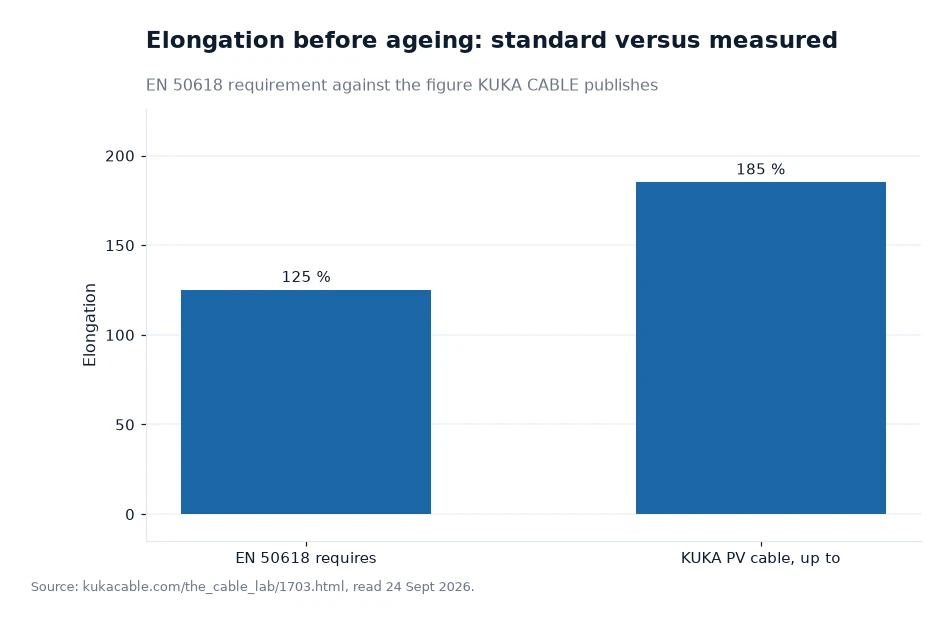
The 1500 V DC cable page gives a rated voltage of 1.8/1.8 kV, a spark test at 10 kV during production, and a test voltage of 6.5 kV AC at 50 Hz applied for five minutes to the finished cable. Rated at 1.8 kV against a nominal 1.5 kV system voltage, the product carries about 20% headroom above the string voltage it is sold for (author's calculation: 1,800 ÷ 1,500 = 1.2), which is a way of expressing margin rather than a published promise. Three checks sit in the list for different purposes: the spark test looks for pinholes in the insulation while the cable runs down the line, the five-minute voltage test confirms the finished article, and the rated voltage states what the installation may apply continuously. The mechanical side is stated in the same place: a tensile strength before ageing of at least 8 N/mm², elongation before ageing of at least 125% against published figures of up to 185%, and a minimum bending radius of four times the outer diameter.
| Demand on the DC side | Published answer | Where the buyer sees it |
|---|---|---|
| Continuous direct voltage | Rated DC 1.8/1.8 kV, 1500 V product family | Product page and nameplate description |
| Long outdoor exposure | XLPO insulation and sheath, cross-linked and LSHF | Construction line on the data sheet |
| Flexing during installation | Class 5 flexible tinned copper to IEC 60228 | Conductor specification |
| Fault heat | +120 °C for 20,000 h, +250 °C for 5 s | Temperature limits table |
| Routine termination | MC4 and other solar connectors, fuse and diode types | Connector range and assemblies |
The models that belong on this side
Three model families are named for the DC side. H1Z2Z2-K is the European designation used for the cross-linked PV cable, PV1-F is the older named type still common in specifications, and UL 4703 covers solar PV wire for the North American market, where the site notes the certificate set is being updated. The 6 mm² example is the size most often quoted, with 4 mm² and 10 mm² named as the commonly used specifications alongside it. Single-core and twin-core versions both exist, and the twin-core form is useful when a pair has to follow the same rail, because one jacket replaces two and the number of clips falls. On the termination side the range includes MC4 and other solar connectors, solar fuse connectors, solar diode connectors and pre-made PV cable assemblies, which is the part of the DC circuit where the published data ends and an assembly drawing is needed instead.
Certificates and standards for the DC line
The standards quoted for the PV line are TUV 2PfG 1169/08.2007, EN 50618:2014 and IEC 62930, and the certificate names published for the network of products include TUV, IEC, CE, SAA, CPR and UL, with more than 30 certificate types listed on the certificates page. The site describes TUV certification as the starting point for the product's expectation of stable performance over more than 25 years with low fire risk, and it highlights two regional requirements that sit outside the standard list: the CPR fire rating and AD8 waterproofing. None of those names replaces a project specification. What they do is set out the tests and the markings a buyer can ask to see, and the DC side is the part of a plant where asking is most worthwhile, because the cable is fixed, inaccessible in places and expected to last as long as the modules next to it.
Why the elongation figure appears with this article
The chart below shows elongation before ageing, which is published data on a different question from the rating table, and it is included here because the DC side punishes the sheath mechanically as well as electrically. The standard requires more than 125%, and the manufacturer publishes up to 185% for its PV cables, around 20% above the requirement. On a rooftop, cable is pulled through clips, bent around rails and walked on before it ever carries current; a compound with elongation reserve keeps its shape through that, where a brittle one cracks and exposes the layers beneath. That reserve is the same reason the 2,000-hour xenon lamp weathering programme, described as equivalent to about 360 cycles, is run on finished cable: the published elongation figure describes the material as supplied, and the ageing tests show what is left of it afterwards.
Worked example: strand count and voltage margin
Two published numbers show how the DC product is built. First the margin: with a rated 1.8 kV on a 1.5 kV nominal system, the headroom is 300 V (author's calculation: 1,800 − 1,500 = 300). Second the conductor: a 6 mm² cable in this family is listed as 84 strands of 0.29 mm, published as a set rather than derived from a formula. The two figures point the same way: the construction carries both the voltage rating of a DC circuit and the flexibility of a cable that has to be routed by hand, and a stiff solid conductor of the same cross-section would meet the electrical need and fail the installation one.
Frequently asked questions
Why can a building wire not be used on the DC side?
The published construction of the DC product is specific to outdoor photovoltaic work: a tinned copper class 5 conductor to IEC 60228, electron-beam cross-linked XLPO insulation and sheath in low-smoke halogen-free compound, a rated voltage of DC 1.8/1.8 kV, and an ambient range of −40 °C to +90 °C. The site presents this as its PV family rather than as a general wiring product.
Which standards should the data sheet quote?
The site lists TUV 2PfG 1169/08.2007, EN 50618:2014 and IEC 62930 for the PV line, with certificate names that include TUV, IEC, CE, SAA, CPR and UL across more than 30 certificate types. A project specification may add regional requirements such as the CPR fire rating or AD8 waterproofing.
What to put in the enquiry
State the system voltage and ask for the rated voltage of the cable in the same units, so 1.5 kV nominal and 1.8/1.8 kV rated can be compared directly. Ask for the conductor construction and the strand count for the size being bought, since 4 mm², 6 mm² and 10 mm² are built differently at the finest level. Request the connector evidence separately from the cable evidence, and name the model family so the reply quotes the right standard, H1Z2Z2-K, PV1-F or UL 4703 wire. Finally, ask for the temperature limits table and the bending radius in writing, because the DC side is where a route is fixed most permanently and where a change later is expensive. The site publishes no pricing, minimum order or lead time, so those items belong in the commercial reply.
Every figure on the DC side of this piece traces to the manufacturer's own website, kukacable.com, read and checked 24 Sept 2026[1].