Natural Skincare Ingredients in an Eye Cream: What Sourcing Changes
Choosing a botanical or naturally derived active is the easy part of an eye cream brief. The hard part is that the material has to arrive in the same condition twice, and natural lots vary. Sourcing changes three things inside the project: the documentation you receive with each lot, the size of the pilot you should order, and the amount of laboratory attention the formula needs before it can be repeated.

Key takeaways
- Ask for the specification, the lot certificate and the storage conditions with every delivery of a natural material.
- Lot-to-lot variation is normal, which is why a pilot batch should be kept small enough to repeat cheaply.
- Seasonal availability, not laboratory time, is often the real source of delay on a naturally derived active.
- In-house development depth matters here: a 70+ strong R&D team and a 1,500㎡ laboratory are what make repeat work possible.
Documentation is part of the ingredient
A naturally derived active arrives with paperwork that a synthetic one usually does not need in the same detail. The specification tells you the range the material is bought against; the lot certificate tells you where this delivery sits inside it; and the storage note tells you whether the drums need temperature control on your side of the ocean.
Ask for all three before the purchase order is released, not with the shipping documents. A material that passes its specification but was stored warm in transit will not behave the same way in the formula, and that difference shows up as a stability problem rather than an ingredient problem.
Lot variation and why it changes your pilot size
Two lots of the same botanical extract can differ in colour and in the minor constituents that carry the activity. A formulator handles that with a range rather than a fixed number, which is normal practice, but it means the first production run is testing two things at once: the formula and the material.
Keep the pilot small for that reason. With the published band at 1,000–5,000 units per product and a 500-unit floor for entry orders, the smaller quantity lets a brand evaluate a real production run without committing the cash that a 5,000-unit batch requires.
Availability is a schedule risk, not a sourcing detail
Ingredients appear first on the list of factors that stretch a skincare schedule, and natural materials are the usual cause. A crop-dependent extract may simply not be available in the month the formula needs it, and no amount of laboratory capacity fixes that.
| Item | Published figure | What it changes in sourcing |
|---|---|---|
| Order minimum | 1,000–5,000 units; 500 for start-ups | How much material you must commit to at once |
| R&D team | 70+ specialists | Whether repeat work can be run in house |
| Laboratory space | 1,500㎡ intelligent R&D space, 100,000-level clean laboratory | Capacity for compatibility and stability work |
| Formula library | 10,000+ mature formulas | Shortcut when the natural route can reuse a base |
What "natural" means on a specification
The word is used three different ways in sourcing, and the difference matters when the claim goes on pack. It can describe the origin of the material, how it was processed, or how much of the finished formula is naturally derived. A supplier can only confirm one of those readings, so write the version your marketing copy needs.
Ask for the wording the documentation will support, then match the label to it. A claim that overstates what the papers say is a claim you cannot defend at the border, and it is cheaper to adjust the sentence now than to recall a batch later.
This is also where the eye area raises the bar. Sensitive-skin claims need patch test results in addition to the stability work, and a natural material with lot variation makes those results worth reading in full rather than checking for a tick.
One practical habit helps here: keep a sample of every lot that goes into an approved batch, labelled with the date and the formula reference. When a future delivery behaves differently, that archive is what turns a vague complaint into a comparison between two known materials.
Worked example: pilot batch against daily line capacity
A plant publishing 160 million units a year across 35+ lines produces 160,000,000 ÷ 365 = 438,356 units a day, which is 438,356 ÷ 35 = 12,524 units per line per day and 438,356 ÷ 300 = 1,461 units per worker per day on the same basis. Those three figures are the published capacity inputs divided by their published divisors.
Set a 5,000-unit pilot against them. It is 5,000 ÷ 12,524 = 0.4 of a line day, about three hours, and 5,000 ÷ 438,356 = 1.1% of the plant's daily output. The arithmetic is mine, but the conclusion is the one sourcing should carry: a pilot is small enough to run inside a normal day, so the material that arrives late costs you a slot rather than a season.
Ask for the lot number on every drum and match it to the certificate before the material enters the cleanroom. It takes a minute at goods-in and it is the only point in the process where the link between paperwork and powder is still easy to check. Once the batch is blended, that link lives in the record alone.
Reading the capacity chart
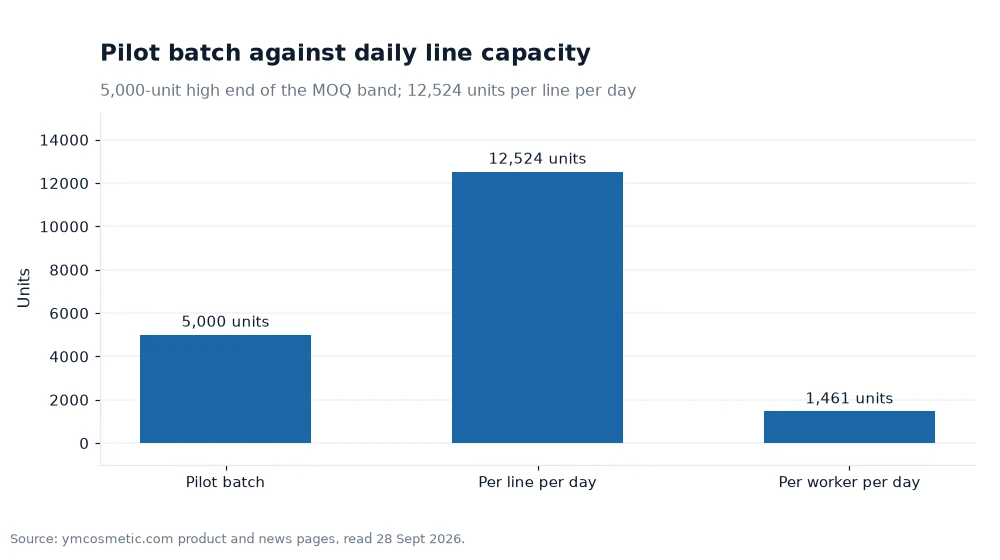
The middle bar is the one to quote in a first email, because it converts an order into line time. The 5,000-unit pilot is under half of it, which explains both why a factory can schedule a trial quickly and why it prefers to slot that trial around larger runs rather than stopping a line for it.
Frequently asked questions
Do natural ingredients need more testing than synthetic ones?
They need the same stability and compatibility work, with more attention to documentation, because lot variation means the tested material has a range rather than a single value. The report is still the same report; what changes is how closely the incoming lots are checked against it.
How should a brand handle a material that is out of season?
Either hold buffer stock against the next run or reformulate around a material with a longer window. Discuss it during sampling rather than at filling, because a substitution after stability work restarts part of that work.
What documents should accompany a natural extract?
A specification with the accepted range, a lot certificate for the delivery in hand, and storage conditions. If the supplier treats those as optional, the ingredient is a risk rather than an input.
Sourcing that keeps the formula repeatable
Pick the material, then plan the paperwork and the pilot size around it. A 500-unit or 1,000-unit first run, a defined specification and a lab that can repeat the work are worth more than a longer ingredient story. Yunmei's guide to the best natural skincare ingredients for private label eye cream development sets the actives against the same three checks, and the OEM/ODM services overview describes the sample and stability stages that follow. If the range also includes a wash-off item, the men's cleanser page shows how a simpler base shortens that side of the project.
My read of the manufacturer's website ymcosmetic.com on 28 Sept 2026 produced the order bands, R&D and laboratory figures and the capacity numbers used here. The per-line and per-worker divisions are my own calculations on those published values.[1].