Message Throughput: What Heavy Usage Looks Like
Heavy use is not a feeling, it is a multiplier. Ten messages a day becomes 300 in a 30-day month, forty becomes 1,200 and a hundred and twenty becomes 3,600, which is twelve times the lightest pace. Understanding which band you sit in explains almost everything else: how much a weak opening costs you, and whether discovery deserves an hour of your month or five minutes.

Key takeaways
- Three bands matter: 300, 1,200 and 3,600 messages a month, from 10, 40 and 120 messages a day.
- At roughly 60 messages a session, those bands imply about 5, 20 and 60 sessions a month.
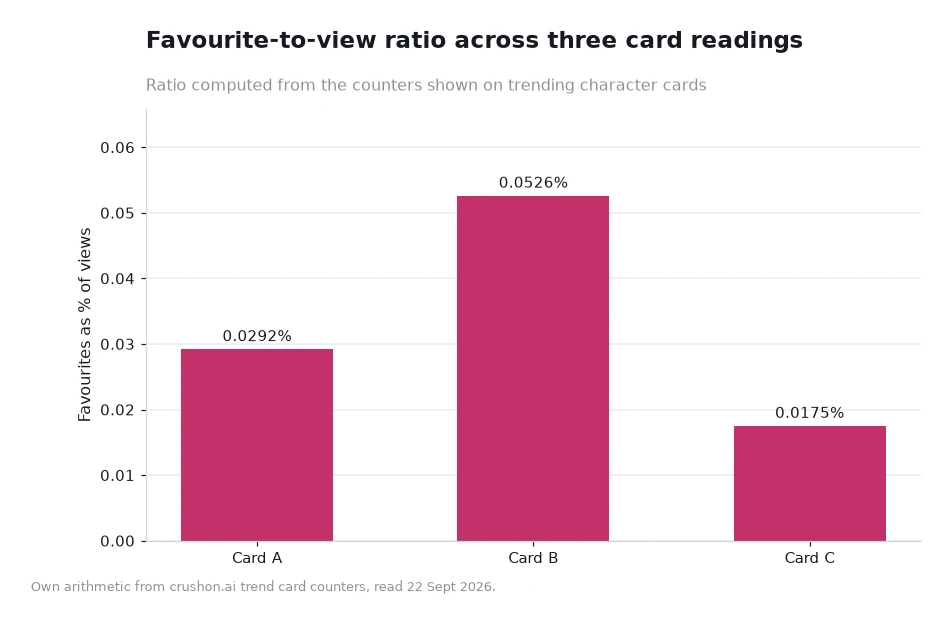
- Conversion rates differ sharply across cards: 0.0526% of views in the strongest reading here against 0.0175% in the weakest.
- Heavy users benefit most from triage. Narrow the field first, because each wasted opening costs more of a fixed month.
Putting a number on heavy
Daily message counts are easier to estimate honestly than monthly ones, because most readers know roughly how much of an evening a session takes. The conversion to a month is multiplication and nothing else. Ten a day is 300 over 30 days; forty a day is 1,200; one hundred and twenty a day is 3,600. Anything above the top band is a session pattern rather than a message pattern and is better described in minutes.
The bands behave differently in practice. A reader at 300 messages a month is choosing carefully by necessity, because a single long thread can consume a large share of the month. A reader at 1,200 has room to test two or three candidates and still hold a main conversation. A reader at 3,600 can afford to explore, and yet is also the reader most likely to notice repetition, because a long month exposes a thin character quickly.
The counter-intuitive part is that heavy usage raises the value of discipline rather than lowering it. When throughput is high, a mediocre choice is repeated dozens of times instead of three or four, so the cost of a bad fit scales with the same multiplier that makes the habit enjoyable.
Bursts and steady paces also behave differently at the same monthly total. A reader who sends 1,200 messages across four long evenings is running four deep conversations, while a reader who sends 1,200 across twenty short ones is running twenty shallow ones. The first accumulates context and the second accumulates candidates, and the discovery routine that suits one is nearly useless to the other.
From messages to sessions
Sessions are the better unit for planning, because every session carries a warm-up cost. Assume 60 messages per session as an illustrative figure, and the arithmetic becomes: 300 divided by 60 is 5 sessions a month, 1,200 divided by 60 is 20, and 3,600 divided by 60 is 60. That reframes the habit from a stream of typing into a countable series of evenings.
Twelve minutes a session is enough to make the time cost visible. Five sessions at 12 minutes is one hour a month; twenty sessions is four hours; sixty sessions is twelve hours. All three are ordinary leisure budgets, and all three change what you should expect from a character: twelve hours a month leaves little room for a companion whose replies repeat.
Keeping a rough log for two weeks is the only measurement you need. Note the minutes and a rough message count per session, total them, and you have your own band without guessing. Most readers find they are one band lower than they assumed, which changes the advice they should follow.
| Band | Messages a month | Sessions a month | What to prioritise |
|---|---|---|---|
| Light: 10 a day | 300 | About 5 | Choosing one character well |
| Moderate: 40 a day | 1,200 | About 20 | One main thread plus a trial slot |
| Heavy: 120 a day | 3,600 | About 60 | Triage by card conversion before opening anything |
| Minutes, not messages | Varies | Varies | Weekly time budget instead of a message count |
| Session length | About 60 messages per session | About 12 minutes each | Cap the session rather than the month |
The fourth row matters more than it looks. Above a certain pace, messages stop being a useful measure because the limiting factor becomes attention rather than typing. At that point a time budget in minutes is the honest tool, and it is the subject of its own habit rather than a feature choice.
Worked example: throughput against card conversion
Pair the bands with the counters and the arithmetic gets sharper. Favourites as a share of views read 0.0526% on one card, 0.0292% on a second and 0.0175% on a third. Per 100,000 views that is 52.6, 29.2 and 17.5 favourites respectively, so the strongest card produces about three times the saves of the weakest from the same exposure.
Now apply it to a heavy month. A reader on 3,600 messages who opens ten new characters has spent a measurable share of the month on candidates, and if six of those sat in the weakest conversion group the expected number of returning favourites is lower than opening four cards from the strongest group. The point is not that ratios decide taste; it is that triage is cheaper at high throughput than at low.
What high throughput changes
Two habits pay for themselves above the moderate band. The first is a standing shortlist: three or four characters kept deliberately, so a session can start warm without a search. The second is a weekly rather than daily look at what is new, since the chart is rebuilt every Thursday and a daily check adds nothing but decision fatigue.
There is also a floor below which throughput stops being a useful measure at all. Under about 300 messages a month the arithmetic is dominated by one or two sessions, so minutes are the honest unit and message counts mostly add noise. Above 3,600 messages the reverse holds and the binding constraint becomes attention rather than typing, which is why heavy readers are better served by a weekly time budget than by a monthly message target they will never hit exactly. Both ends of the scale point to the same habit: measure whatever actually restricts you, and plan around that.
Do all three and the heavy month stops feeling like a slot machine. A reader who wants the mechanics of the format laid out before committing a month's throughput can read the platform's own description of porn ai chat, where the feature set appears under the heading Porn Chat AI in the client's own words; the unlimited plan page is the other half of the same decision.
Frequently asked questions
How many messages a month is a lot?
Three thousand six hundred, which is 120 a day over a 30-day month. It is twelve times a light pace of 300 and it is the band where triage starts to matter most.
Should I count messages or sessions?
Sessions, usually. They carry the warm-up cost and they map onto a time budget, while a message count is mostly useful for comparing one month with another.
Does heavy use require a different kind of character?
It rewards one that holds up over repetition. Long months expose thin character definitions faster, which is why cards with strong save rates are a better starting point.
Measure the habit, then spend it well
Log two weeks of sessions, convert the totals to a monthly band, and decide your discovery routine from that number rather than from a feeling about how much you use the platform. High throughput is not a problem to solve; it is a budget to allocate, and it deserves the same twenty minutes of planning as any other recurring hobby.
Sources: the trend-card counters behind the 0.0526%, 0.0292% and 0.0175% ratios were read from Crushon on 22 Sept 2026; message and session totals are illustrative arithmetic based on a 30-day month and are not platform statistics.[1] Intended for readers aged 18 and older.