How to Read Fresh Kingshot Reward Lists Without Wasting Time
Reward pages for Kingshot change faster than most casual players expect. A careful player can usually avoid three common mistakes: using an old list, entering the string on the wrong account, or missing a short claim window after a patch.

Key takeaways
- Check the source date first; a list older than 30 days needs extra caution.
- Confirm the account, region, and platform before entering a reward string.
- One failed attempt should be followed by a clean copy-and-paste retry, not random edits.
- Keep one short record of claimed rewards so repeated-use errors are easier to spot.
Start with the page date, not the code string
The first question is not whether a reward looks attractive. The first question is whether the page was checked recently enough to matter. Players often save a screenshot, find it again weeks later, and treat it as current. That habit creates confusion because mobile games rotate rewards around patches, maintenance, social campaigns, and seasonal events. For Kingshot, a list that was useful yesterday may still be fine today, but a list copied from an old forum thread may only explain why a message fails. Look for a read date, an update note, or a page that clearly separates active and expired entries. If a page does that work for you, it reduces the number of blind attempts on your account.
A simple routine works better than a long search session. Open the reward page, read the newest note, and scan the top group before touching the claim screen. If you need a current reference, use active Kingshot codes as the source you check before testing an entry. Do not paste every string at once. Try one, read the exact result message, and write down whether it was accepted, used, expired, or unavailable for your account.
Match the reward to the right account context
Reward systems rarely judge a string in isolation. They also look at the player account. The player profile may be on a certain server, bound to a certain login method, or affected by an event that has not opened in every region. This is why two friends can test the same entry and see different results within the same hour. One account may have claimed it earlier, one may be outside the eligible region, and one may be on a platform where redemption runs through a different path. These differences are not always explained in the error message, so the safest method is to verify the boring details before assuming the list is wrong.
For Kingshot players, the useful details fit on one line: account nickname, region, platform, the date tested, and the exact message returned. That record prevents a second round of guessing later. It also helps if support asks what happened. A player who can say that an entry was tested on 10 Oct 2026, after a clean paste, on the correct profile, has a clearer case than a player who only remembers that something did not work.
Use a five-step check before retrying
The order of checks matters because it saves time. Freshness should come before spelling. If a reward is already marked expired, a perfect copy will not help. Region comes next because a valid string can be limited to selected servers. Entry format is third: extra spaces before or after the string are small but common. Claimed status is fourth, since many games allow a reward once per account. A final retry comes last, and it should be done after closing and reopening the relevant screen so a stale session is not part of the test.
| Step | What to check | Why it matters |
|---|---|---|
| 1 | Page freshness | Old lists are the most common source of failed attempts. |
| 2 | Region or server | Eligibility may differ between accounts. |
| 3 | Clean entry | Case, spacing, and copied characters can change the result. |
| 4 | Claim history | One-time rewards can show as already used. |
| 5 | Short retry | A fresh session catches temporary loading issues. |
Worked example
Assume a player finds 5 entries and wants to test them without losing track. The clean method is to spend about 2 minutes on the page date and source notes, then 1 minute checking the account region, then roughly 30 seconds per entry for copy, paste, result, and record. That is 2 + 1 + (5 × 0.5) = 5.5 minutes. The slower method is to paste all 5 first, search every error afterward, and retest from memory. Even if that second pass takes only 2 minutes per failed entry, three failures turn into 6 extra minutes. The checklist is not fancy, but it changes a messy 10-minute guessing loop into a short review that leaves a useful record.
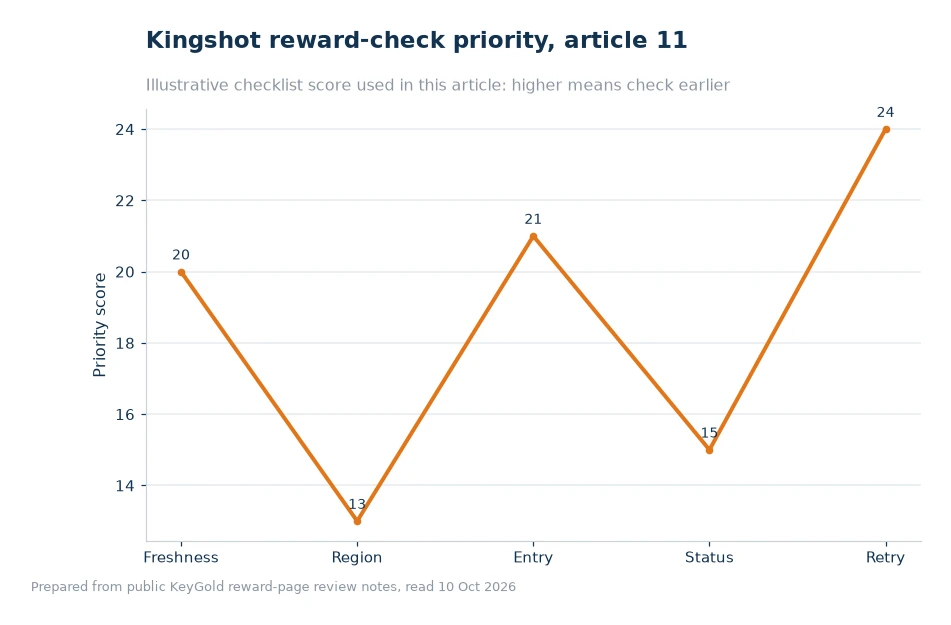
Read the result message carefully
The exact wording after a failed entry is often more useful than the string itself. A message about previous use points to account history. A message about expiration points to timing. A message about format points to copy problems. A blank or spinning screen points to network or session trouble. Treat these as separate paths. Changing the reward string when the problem is account history will not help, and changing the account when the issue is an expired event will only waste time. The goal is to identify the category of the failure before taking the next action.
This is where login session and cache refresh become practical instead of abstract. If the source page says an entry is active but the account reports previous use, the page and the account can both be correct. If a page lists a reward after a maintenance window, but your server has not received that phase yet, waiting can be smarter than forcing more attempts. If a copied string contains a hidden line break, a plain-text note app can reveal the problem quickly.
Keep reward tracking simple
Players do not need a complicated spreadsheet. Four columns are enough: reward label, date tested, result, and account. Add a fifth column only if you manage more than one server. The value of the record appears later, when a page is updated and one line looks familiar. Instead of wondering whether you used it, you can check your own note in a few seconds. This also helps players who switch between iOS, Android, and desktop routes because the entry path may feel different even when the account result is the same.
For rewards tied to Gems, avoid planning upgrades around unclaimed values until the account shows the items. A public list is a lead, not inventory. When the reward appears in mailbox or account balance, then it becomes part of a spending plan. That small distinction keeps expectations realistic and avoids decisions based on rewards that may be region-limited or already closed.
When a fresh page is better than a saved screenshot
Saved screenshots are useful for memory, but they age silently. A live page can show changes, moved entries, and notes about removed rewards. It can also point players toward broader game-purchase or guide resources without sending them through random reposts. If you use KeyGold game guides as a starting point, still check the specific page for the game before entering anything. Broad navigation helps you find the right area; the detail page helps you avoid stale information.
The same logic applies to code length. A short guide can explain the process, but the current page decides what should be tested today. When in doubt, compare the listed update time with the game event calendar. If the dates do not line up, pause before making more attempts. A pause of one minute is better than locking yourself into repeated failure messages.
Frequently asked questions
Should I copy a Kingshot reward string by hand?
Copying is safer than typing because one changed letter, hidden space, or wrong case can make a valid reward look invalid.
Why does the same Kingshot reward fail on another account?
Most rewards are limited by time, region, account state, or previous use, so a result on one account does not prove the same result on another account.
How often should players recheck a reward page?
A quick check after major updates, server resets, and event announcements is usually enough for normal players.
A practical next step
Before the next Kingshot event, prepare one clean note with your account region, last claim date, and the result message pattern you saw most recently. Then check the current reward page, test one entry at a time, and stop when a message clearly says the reward is expired or already used. That small habit keeps the process calm and makes future checks faster.
Source: public KeyGold reward-page review for Kingshot, read 10 Oct 2026[1].