A manufacturer can be established and still be a poor fit for a particular product, order size, market, or delivery schedule. Buyers should translate requirements into evidence they can compare: product and process capability, model-specific samples, production controls, capacity for the requested configuration, communication, and documented responsibilities. Screening works best when the same questions and decision criteria are applied to every candidate before price alone narrows the field.
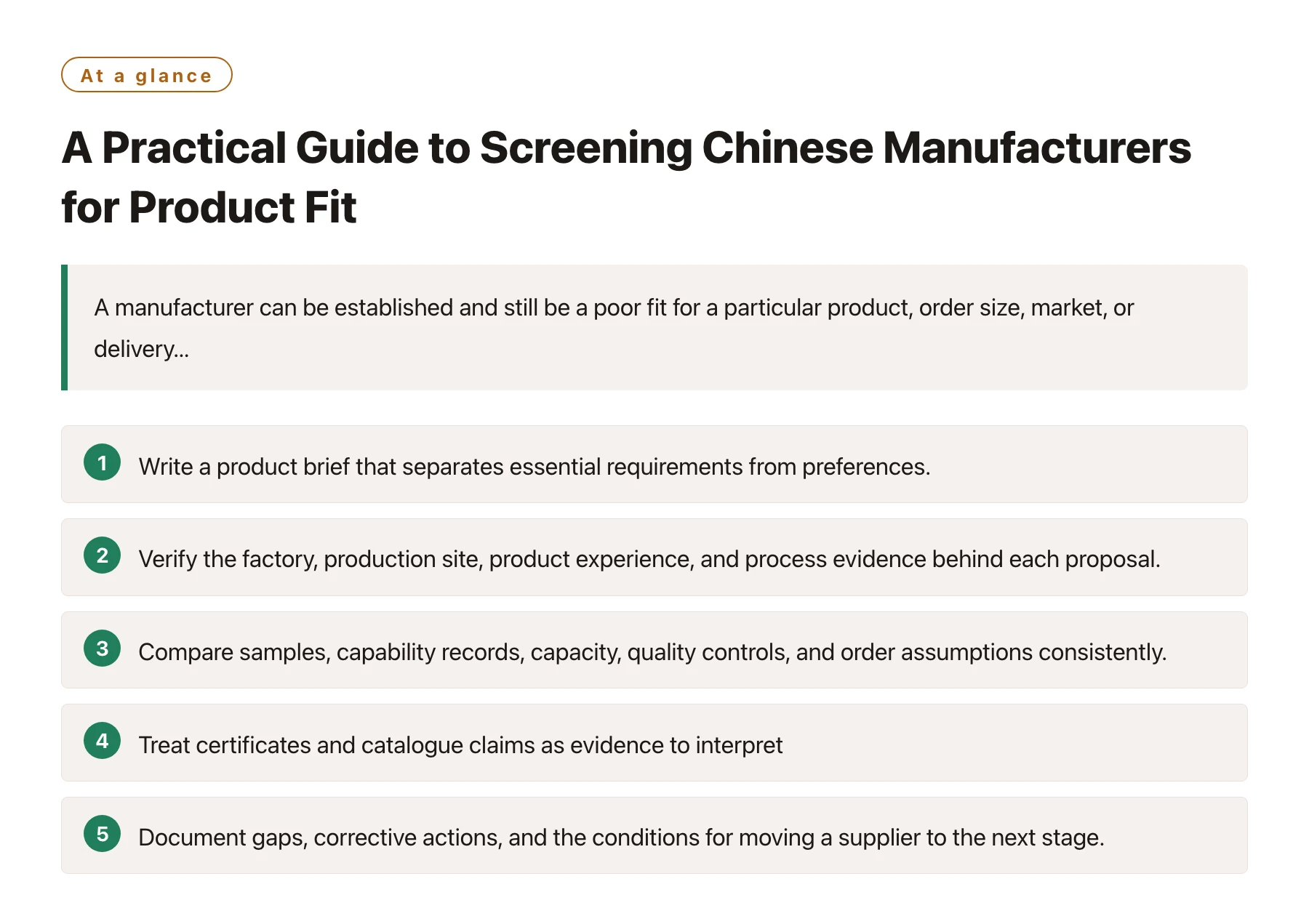
Key takeawaysWrite a product brief that separates essential requirements from preferences. · Verify the factory, production site, product experience, and process evidence behind each proposal. · Compare samples, capability records, capacity, quality controls, and order assumptions consistently. · Treat certificates and catalogue claims as evidence to interpret, not substitutes for product review. · Document gaps, corrective actions, and the conditions for moving a supplier to the next stage.
Use a staged review: desk screening first, then sample and process evidence, followed by commercial and production readiness checks for shortlisted candidates.
Define fit before contacting factories
Start with a concise brief that describes intended use, target market, product configuration, materials, dimensions, function, finish, accessories, packaging, order quantity, and required delivery window. Mark each requirement as mandatory, preferred, or unresolved. This distinction lets a supplier identify a genuine mismatch rather than hiding it inside a broad quotation. It also prevents different candidates from pricing different assumptions.
Identify the evidence needed for each critical requirement. A drawing may clarify geometry; a bill of materials can show components; a sample can help review fit and finish; a production flow may clarify process controls; and a test record may support a particular performance claim. Decide who will evaluate each item and what would count as adequate evidence before the proposals arrive.
Buyers seeking options can begin by finding Chinese manufacturers for wholesale orders. Treat discovery as the start of screening, not the conclusion. A directory listing, trade-fair conversation, or introduction can identify a candidate, but the buyer still needs to connect the named supplier, actual production site, product capability, and commercial offer.
Verify who will make the product
Record the legal or trading entity, factory address, contact people, and the role each party will play. Ask whether production is performed at the named site or whether any process is subcontracted. If a sales company, trading company, or sourcing intermediary is involved, clarify who controls the factory relationship, who owns quality decisions, and who is contractually responsible for delivery and remedies. The relevant structure depends on the purchase; do not assume a website name equals the producing factory.
Request a walkthrough or other evidence of the processes that matter to the product, such as machining, molding, sewing, assembly, finishing, testing, or packing. Keep questions specific to the order. A large facility or polished presentation does not itself establish that the supplier has the equipment, trained personnel, process discipline, or available capacity needed for the offered configuration.
When reviewing business and quality documents, match names, addresses, scope, dates, and issuing parties. An organization-level certificate can indicate a management system for a defined scope, but it does not prove that a specific product complies with every specification or destination-market rule. The International Organization for Standardization describes ISO 9001 as a quality-management-system standard; buyers should check the certificate’s validity and scope and separately assess product evidence. [1]
Compare capability with the product requirements
Ask candidates to explain which processes they perform in-house, which are outsourced, and how each critical feature is controlled. For example, a product may depend on a finish, tolerance, electrical component, assembly sequence, or packaging method that is not visible in a catalogue. Ask what equipment or work instruction is used, how operators identify the current revision, and what record shows that the requirement was checked.
Request examples of product families or processes that are relevant to the order, while respecting confidentiality. Focus on comparable materials, complexity, quality risks, and production scale rather than relying on broad statements such as “we make everything.” If the supplier proposes a substitute process or component, ask what changes in performance, cost, timing, test evidence, and maintenance follow from it.
Map each mandatory requirement to a person, process, and evidence source. A simple table can show requirement, supplier response, evidence received, reviewer, gap, and status. This highlights where a candidate has a real strength, where evidence is incomplete, and where the buyer must decide whether a gap is acceptable or disqualifying.
Use samples to test the offer
Order samples that are tied to the proposed model and commercial configuration. Record the date, revision, materials, finish, components, and any differences from the production version. Compare each sample with the brief using the same review sheet for every candidate. Evaluate only what the sample can show; a sample cannot establish routine production consistency, available capacity, compliance for all markets, or the quality of an unseen production run.
Test fit, function, finish, dimensions, interfaces, assembly, and packaging according to the product’s use. Involve the people who will operate, install, sell, maintain, or service the item when their feedback affects the acceptance criteria. Capture nonconformities as specific observations and give suppliers the same opportunity to respond or provide a corrected sample. Keep the rejected and accepted revisions clearly distinguished.
Compare promises against physical and documentary evidence. If a supplier claims a feature but the sample or test record does not show it, treat the claim as unresolved. Ask whether the production version will differ and how the difference will be controlled. An approved sample should be linked to a dated reference and purchase specification before it becomes a production benchmark.
Review quality controls and change handling
Ask how incoming materials, in-process steps, final checks, nonconforming product, and corrective actions are handled. The appropriate depth depends on product risk and order scale. Look for a clear method to identify defects, isolate affected units, decide disposition, and confirm that a correction worked. A written procedure is useful only when the supplier can show how it applies to the relevant product and production site.
Clarify how the factory controls drawings, specifications, and revisions at workstations. Agree that changes to material, component, process, tooling, subcontractor, or packaging require written review when they can alter product performance, appearance, safety evidence, or cost. Establish who can approve a deviation and how the approved change will flow into production and inspection records.
Discuss pre-shipment checks before the order is placed. Define inspection timing, sample selection, checks, acceptance criteria, access to records, and the release process. If a supplier resists clear criteria or cannot explain how a known issue will be contained, record that as a screening gap and decide whether further evidence is warranted.
Check capacity, timing, and communication
Request a schedule that separates material procurement, sample approval, production, inspection, packing, and dispatch. Ask which dates depend on buyer decisions and how the supplier manages peak periods or constrained inputs. Capacity claims should refer to the requested model, configuration, quantity, and timeframe. If several orders compete for a production line, learn how priorities are assigned and when the buyer will be told about a delay.
Evaluate communication through concrete interactions: response completeness, handling of technical questions, escalation path, and willingness to document assumptions. A fluent sales conversation is not a substitute for an accountable production contact. Identify who resolves engineering questions, who shares schedule updates, and who authorizes shipment release. Confirm how language or time-zone differences will be handled in routine work.
Normalize quotations before comparing them. Align quantity, model revision, packaging, tooling, samples, inspection, spare parts, payment assumptions, delivery point, and validity. List exclusions and alternative offers separately. A low price may reflect a different material, test scope, carton, or responsibility split; the comparison should make those differences visible.
Make a decision with explicit conditions
Use a scorecard only if the criteria and weights reflect the order’s real priorities. Typical dimensions include product capability, evidence quality, sample result, quality controls, capacity, schedule, communication, commercial terms, and unresolved risk. Avoid false precision: a numerical total cannot compensate for a mandatory requirement that remains unsupported. Record both the score and the evidence behind it.
Separate candidates into practical next steps: decline, request missing evidence, revise the offer, conduct a site or process review, or approve for a controlled trial order. For conditional advancement, name the condition, owner, due date, and evidence needed to close it. Keep the decision linked to the specific model and order rather than labeling an entire company universally suitable or unsuitable.
After a first order, compare actual quality, schedule, responsiveness, and change control with the screening assumptions. Record issues by product, site, lot, and order. Use the results to adjust future qualification questions and inspection controls. This feedback helps procurement decisions improve without turning an isolated experience into an unsupported claim about all manufacturers in a region.
Sources
Frequently asked questions
Does a quality-management certificate prove a product is compliant?
No. It concerns a defined management-system scope. Buyers still need product-specific evidence and market review for the exact model and use.
Should the lowest quotation determine which manufacturer is selected?
Compare offers on the same model, revision, quantity, packaging, test scope, and delivery assumptions. Price is meaningful only alongside those differences and the buyer’s requirements.
What is the most useful first screening document?
A product brief that separates mandatory requirements, preferences, open questions, quantities, destination market, and timing gives suppliers a comparable basis to respond.
Can a sample confirm that future production will match?
A sample shows one configuration at one time. Link it to production controls, inspection criteria, revision records, and change approval to manage later production.